Once – and not so terribly long ago – just about ALL wood finish products were made with beeswax. But mass-produced products made without beeswax (largely to save money) gradually eased beeswax wood finish products to the back of the shelf.
In recent years, though, beeswax-based products have been making a comeback. And for some very good reasons.
People Are Searching for a More Natural Alternative
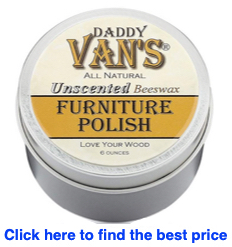 Why are beeswax-based wood finishes becoming popular again?
It’s partly because people are searching for a natural alternative to modern wood finishing products – products that often contain some rather nasty chemicals, such as toluene.
(Note: Toluene, which for many years has been a mainstay ingredient in many wood finishing products, could definitely be considered ‘a less desirable substance.’ Toluene has been associated with a range of illnesses, and is suspected of being linked to certain birth defects. If you’d like a nice scare, read the CDC’s data sheet on toluene.)
What’s Old Is New Again
The resurgence in the use of beeswax as a wood finishing product is a classic case of ‘what’s old is new again.’ Because beeswax has been used for centuries to protect wood and help bring out its glossy natural patina.
That’s because a beeswax polish or finish offers some really nice advantages that are hard to beat.
And you don’t have to worry about finding beeswax on the CDC’s ‘bad’ list.
The Advantages of Beeswax Wood Finish
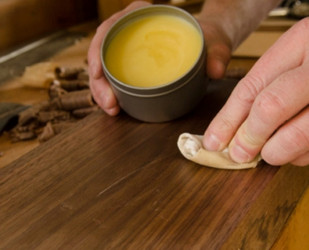 The most obvious advantage of a finish or polish made of beeswax is that it’s natural – or at least the beeswax portion is natural.
As concerns mount about pollutants in our homes (you’ve probably heard that the most polluted air you breathe may be in your own home), many of us are actively seeking ways of eliminating some of those sources of pollution.
And a furniture polish containing ‘bad’ ingredients can be a significant source of indoor pollution.
After all, we not only breathe the air that may have been contaminated by the polish, our skin is in constant contact with it as we use the wooden furniture for its intended purpose.
So eliminating furniture polish as a potential source of indoor pollutants makes a significant contribution to making our homes safer and healthier.
Some Beeswax Combined With Questionable Ingredients
 Be aware, though, that there are products that combine beeswax with a number of questionable ingredients like toluene.
So if you’re buying a commercial wax or polish, be sure to read the ingredient list carefully.
The fact that a product contains beeswax doesn’t eliminate the possibility of that product also containing a less desirable substance.
Best Beeswax Wood Finish Options
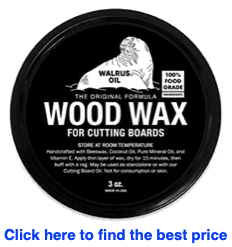
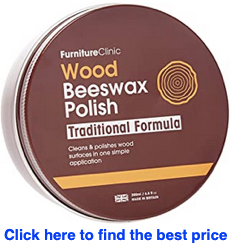
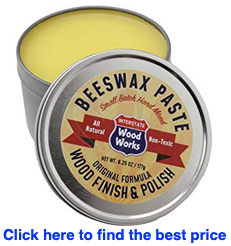
Beeswax Provides a Natural Looking Finish
Beeswax is a natural for bringing out the true beauty of wood. It forms a rich, glossy patina that embellishes rather than distorts the natural beauty of the wood. It also leaves wood silky-smooth to the touch.
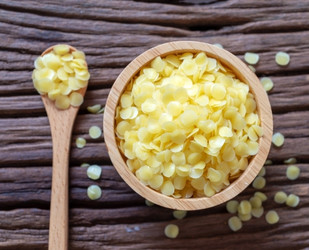
Beeswax Can Be Ingested Safely
 You’re not going to be nibbling on your wooden furniture, of course. (Or do I assume too much?!)
But if you were to do so, you wouldn’t have to worry about the polish – if it’s made of beeswax.
Beeswax is perfectly safe for human consumption. (I eat it intentionally every time I chow down on comb honey!).
So a natural wood polish or finish containing beeswax (again – check the other ingredients) is a great choice for children’s toys made of wood. Because those DO end up being nibbled upon at times.
And of course, beeswax is perfectly safe to use in a salad bowl finish or a cutting board finish.
The Disadvantages of Beeswax Wood Finish
Yes, there are a couple.
As a primary wood finish, a paste wax made with beeswax (or other waxes such as carnauba) doesn’t offer quite as much protection as do other finishes such as lacquers, shellacs, varnishes and oil finishes.
But beeswax is excellent when used as a polish over another type of finish.
And a beeswax finish typically won’t last as long as some other products. So you’ll have to reapply it a little more frequently.
By the Way: Beeswax is Great for Leather, Too
Beeswax has been used for thousands of years as a conditioner and waterproofing agent for leather.
And it’s still hard to beat for that purpose.
Beeswax helps to protect leather, makes it soft and supple, and also gives it a nice shine.
Recommended Products
Want to buy some safe wood finishing products made with beeswax?
Each of these products is made without nasty chemicals like toluene. Each, in fact, are safe to use on items like cutting boards, salad bowls – and even children’s toys.
All the benefits of beeswax without the dangers posed by some ‘modern’ products.
Sometimes, the old ways are simply better. Here are a few great choices: