Hive inspections don’t need to be made very frequently, but it is important to be sure that the queen bee is laying. And that’s the purpose of today’s hive inspection.
Hive Inspection – April 24
Looking For Eggs
All I need to do today is spot some eggs showing that the queen is laying. There’s no need to actually find the queen.
If I don’t see any eggs I won’t panic quite yet, but the queen should be laying by now.
And actually, I can predict with near certainty that she is laying without even opening the hive.
Signs Queen Is Laying Eggs
I can make that prediction because while watching foragers return to the hive, I’ve noticed a number of them bearing heavy loads of pollen as they plop down on the landing board. That’s a good sign that the queen is laying eggs, and the process of raising brood is underway.
Once you know what to look for, you can actually surmise quite a lot about the condition of a bee hive from outside.
But the only way to be certain, of course, is to take a look inside.
So let’s do that…
Everything’s Looking Good
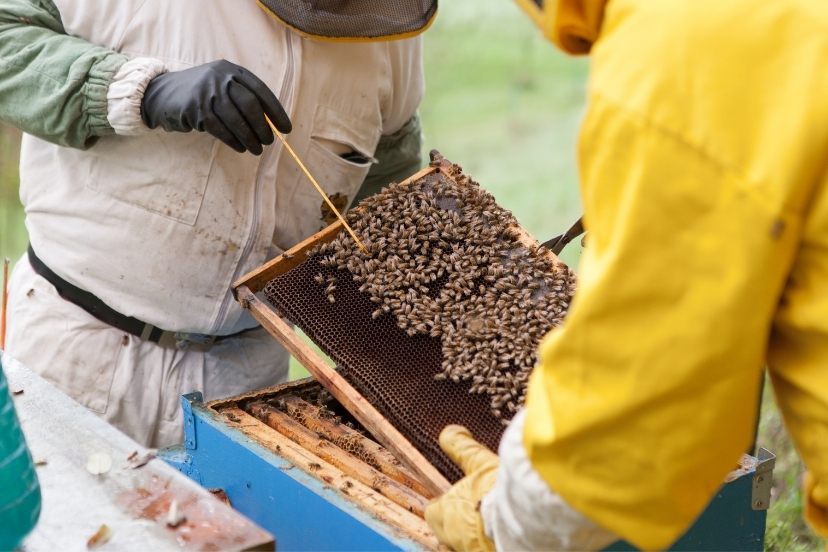
As you can see, the bees have made good progress in building comb. And the queen has started egg laying. Though they’re hard to see, there are eggs in the bottoms of many of the cells. You might be able to spot some in the photo below where I jarred most of the bees off the comb.
Disturb Bees As Little As Possible
I probably won’t open the hive up again for a couple of weeks. It’s best to disturb the bees as little as possible. If you’re a beginning beekeeper, that might raise a quandary. You’re excited about your bees, and may want to open the hive frequently to see how they’re doing.
Completely understandable!
No More Than One Inspection Per Week
But try to restrict yourself to no more than one inspection per week. Remember that every hive inspection creates a considerable disturbance for the bees.
It takes them quite a while to get back to normal.
Hive Inspection – May 16
Today’s inspection revealed that everything’s still looking good. My hive is off to a great start!
Removed Feeder From Hive
On May 6, I removed the feeder from the hive. All together, I’ve fed the bees a total of about 7 pounds of sugar. More than was necessary, really.
When I received my package bees and started the hive, the big springtime nectar flows were already underway. With such an abundance of forage available for the bees, I didn’t really need to feed them for as long as I did. Better, though, to feed more than necessary rather than not enough.
If you’re going to be starting a hive from package bees, you may find it necessary to feed them for much longer than I did. It just depends upon where you live, and what’s available for the bees when they arrive.
If you’re located at a more northerly latitude, there might not be a lot of forage available for the bees at the time you receive your package.
Also, it might still be too cold for them to forage on some days. The rate at which the bees are taking the feed is a good indication of how badly it’s needed. For about a week before I removed the feeder, the bees were hardly taking any, so I knew it was no longer needed.
Lots of Brood
As you can see in the photos above, the queen has been doing her job. There’s lots of brood in all stages. Very soon, the population of the hive will start to increase at a rapid pace as young bees begin to emerge.
Since the hive is now well established, I decided to remove the entrance reducer. It’s beginning to get hot, and the bees will need to be able to air condition their hive. Having a restricted entrance makes it more difficult for them to do that.
Next Inspection Will be in a Few Weeks
My hive is well established, there’s plenty of forage for them, and the queen is doing a good job. There’s no need for me to disturb them with frequent hive inspections.
I’ll take another peek in a few weeks just to be sure all is well. Until then, I’ll just enjoy my bees by watching them from the outside.
I could (and have!) spend hours just sitting by the hive entrance, and watching the activity of the bees coming and going. (Yea, I know, you’re probably thinking this guy really needs to get a life!)
But to me, watching my bees is kind of like watching a campfire. It’s somehow mesmerizing, always the same and yet always different. At least it’s cheap entertainment!
Hive Inspection – June 13
Took a quick look in the hive today just to be sure everything’s OK. The colony is definitely increasing in population.
For the first several weeks after hiving a package, the population of a new colony steadily declines as older workers reach the end of their life.
It’s not until the new queen’s brood starts hatching out that the population begins to increase instead of decreasing. I’ve reached that point now with my hive. Lots of young bees have hatched out to take the place of the original package population.
In fact, at this point it’s pretty likely that the queen (and perhaps some drones) are the only bees surviving from the original package. But the package bees did their job, and got their colony established.
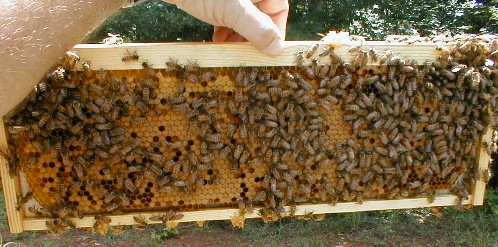
And the queen is doing her job, as the photo shows. That’s an excellent brood pattern, which is an indication of a strong young queen. My job now is just to keep a watchful eye without meddling. (The bees don’t really need much help from me, thank you very much!).
The next hive inspection will be in a few weeks. Until then, I’ll hope for a few timely summer showers to help prevent nectar flows from dwindling away in the summertime heat.
Hive Inspection – July 18
Another quick look today – everything’s fine. The colony continues to grow (look at that beautiful, full brood pattern in the photo!).
We’re in the summer doldrums right now. This is actually a pretty sparse time of the year for the bees. If it’s a normal year (but what year is?!), there’ll be some good honeyflows in the fall, and it looks like my hive will be plenty strong to capitalize on them.
Odds are good that they’ll be able to lay in enough stores to see them through the winter and early spring. And then hopefully the hive will be a buster going into the next honey season!
I Also Added a Third Medium-Depth Super…
They don’t really need the room yet; they haven’t quite drawn out 100% of the original foundation. But the extra room will help with hive congestion.
And since I’m using plastic-based foundation, I don’t have to worry about it warping or being chewed by the bees. The foundation will be in good shape when the bees are ready for it.
As you can see in the photo, I also gave the hive an upper opening by just slightly staggering the top super. This will help the bees in ventilating the hive through the hot days of summer.
It’ll also reduce hive congestion by providing an alternate entrance for returning foragers. They won’t have to make their way through the crowded brood nest just to drop off their loads of pollen and nectar.
If this had been a strong, established hive, I’d have given them the upper entrance much earlier in the season.