So what is a hive tool? To those unfamiliar with beekeeping, the name might be a little bit deceiving. If you don’t know better, it sounds like it might be a tool for building or fixing beehives. But actually, it’s not a tool for working ON beehives, it’s a tool for working WITH beehives.
Simple but Essential…
Hive tools are simple little tools. They come in many sizes and designs, but they are all intended to assist beekeepers in the task of working their hives.
And though they are indeed simple tools, they are as indispensable as is a simple little screwdriver when you need to drive a screw. When you need to torque that screw down, you really need to have a screwdriver, because nothing else will do the job right.
And when you work your bees, you really need a tool designed for that purpose. It’s the right tool for the job.
There Are Many Different Hive Tool Variations
If you are new to beekeeping, you will probably need to experiment with some different variations of hive tools to find the design that you prefer.
A common design feature among all of them is a flat, sharp blade on one end – kind of like a putty knife, except much stronger. This part of the tool is for prying apart hive bodies, or loosening covers, or scraping propolis or wax off of hive parts, or umpteen other potential uses.
But the other end of the tool is where there is some variation.
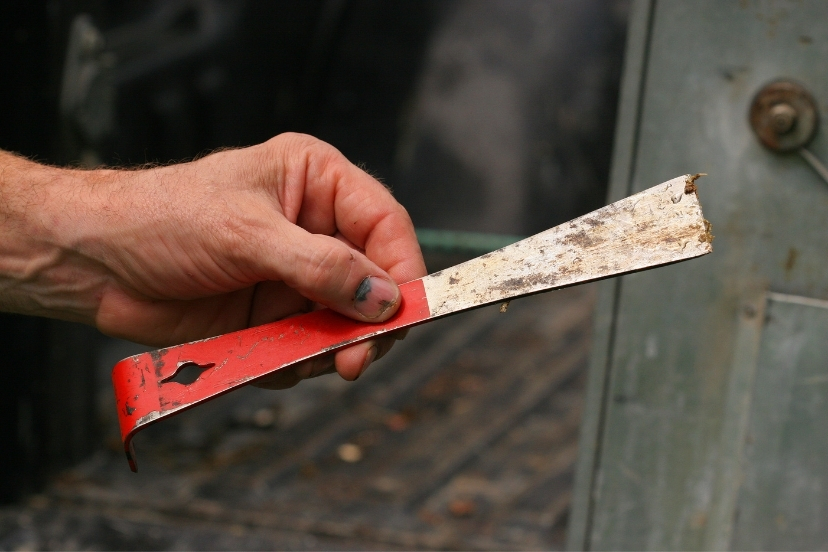
Some designs have another sharp, blade-like end, but with a bend to it. This style usually also has a slot intended for hooking the head of a nail and prying it out.
This design is called a standard hive tool:
The other prevalent style (my preference) has a heavy-duty, flat hook on the other end. The hook is for inserting under the end bar of a frame, and then prying the frame out by leveraging against an adjacent frame.
Working a frame out in this manner seems far more efficient and practical to me than trying to pry it out with the sharp blade of the first style.
This type of hive tool is often called a frame lifter, or a J-type tool:
Choosing the Right Hive Tool For You is Important…
Though it may sound a bit silly, having a tool that you are comfortable with when working your hives is actually pretty important.
Trying to drive that screw with the blade of a knife rather than the proper screwdriver is asking for an accident.
Similarly, trying to work your hives with a tool that is awkward to use means that you are not working as smoothly as you could.
And bees like smooth!